Midleton Distillery: Where Irish Whiskey Lost Its Way, Found Its Feet, and Learned to Dream Again
There are distilleries you visit, and there are distilleries you feel.
Midleton firmly belongs in the second camp.
Long before I ever set foot on its grounds, Midleton already loomed large in my personal whiskey universe. Not just as a name on labels I loved, but as a place that quietly carried the weight of an entire category on its shoulders. Visiting Midleton — and later studying there — didn’t just deepen my appreciation for Irish whiskey. It fundamentally rewired how I understand it.
Because if Irish whiskey has a beating heart, it beats in County Cork.
Irish Whiskey Before the Fall: When Ireland Ruled the World
It’s hard to imagine today, but there was a time when Irish whiskey didn’t play second fiddle to anyone. In the 19th century, Ireland was the undisputed global powerhouse of whiskey production. Dublin alone boasted giant distilleries whose output dwarfed anything being made in Scotland at the time. Irish pot still whiskey — rich, oily, complex — was the gold standard.
The foundations of what we now call “Irish style” were laid here: unmalted and malted barley distilled together, large copper pot stills, and a focus on weight and texture rather than smoke. Whiskey was serious business, and Ireland was winning.
Midleton’s story begins right in the middle of this golden age.
From Wool to Whiskey: The Birth of Midleton
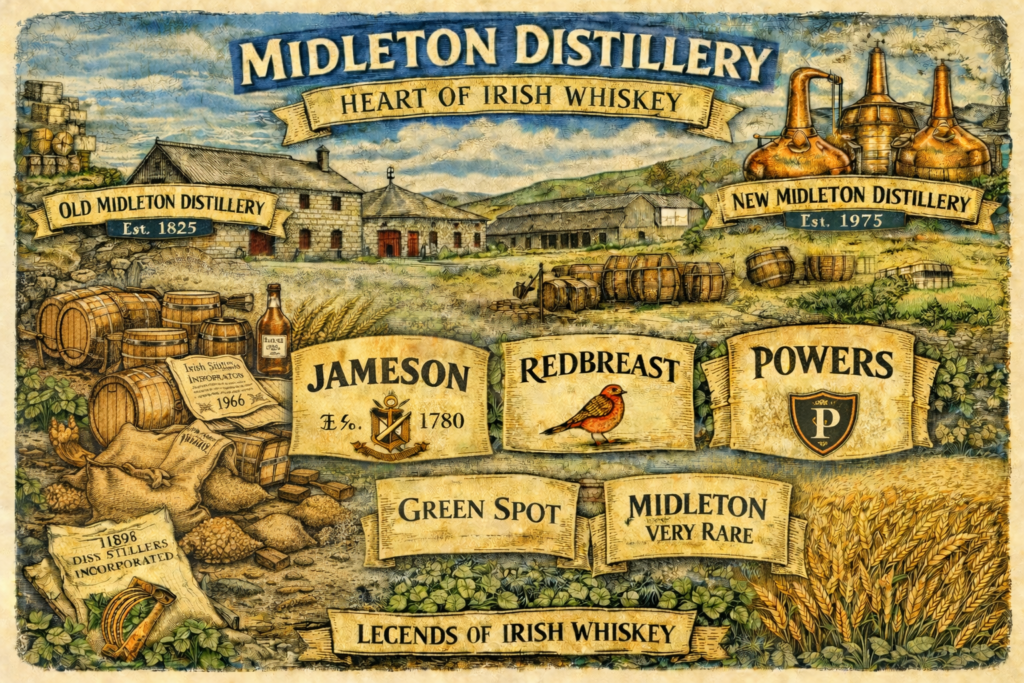
In 1825, brothers James, Daniel and Jeremiah Murphy converted a former woollen mill in the town of Midleton into a distillery. What became known as the Old Midleton Distillery quickly grew into a formidable operation. At its peak, it housed the largest pot still in the world — an almost mythical copper giant that symbolised Irish whiskey’s confidence and ambition.
This wasn’t just industrial scale for the sake of it. It was a statement: Irish whiskey was here to dominate.
And for a while, it did.
The Long Decline: How Irish Whiskey Nearly Disappeared
Then came the fall — slow, painful, and largely self-inflicted.
Trade disputes with Britain, the Irish War of Independence, Prohibition in the United States, and a stubborn refusal by many Irish distillers to adapt to changing tastes all combined into a perfect storm. While Scotch producers embraced blends and export markets, Irish distilleries clung to tradition and paid the price.
By the mid-20th century, once-great names had vanished. Distilleries closed at an alarming rate. Irish whiskey, which had once ruled the world, was reduced to a handful of survivors.
Midleton didn’t escape unscathed — but it adapted.
A Crucial Decision: Consolidation and Survival
In 1966, a pivotal moment arrived. The remaining major Irish producers — including Jameson, Powers and Cork Distillers — united to form Irish Distillers. Rather than letting the category die with dignity, they chose to fight for it.
Midleton was selected as the future of Irish whiskey production.
A bold, modern facility was built alongside the old distillery, and in 1975 the New Midleton Distillery officially took over production. It was a radical shift: all major Irish whiskey brands under one roof, shared knowledge, shared stocks, shared fate.
At the time, it was about survival. In hindsight, it saved Irish whiskey.
Walking the Grounds: History on One Side, Scale on the Other
What makes Midleton Distillery so special is that you can see this transition in real time.
On one side of the road stands the Old Midleton Distillery, now preserved as a living museum — stone buildings, waterwheels, and those legendary pot stills frozen in time. On the other side lies the New Midleton Distillery: vast, efficient, and frankly mind-bending in scale.
It was during my time at the Irish Whiskey Academy that this contrast truly hit home.
The Midleton Whiskey Academy: Knowledge at Full Throttle
Last year I travelled to Midleton together with Bob Wenting — Head of the Benelux Chapter of the Scotch Malt Whisky Society, founder of Comedus, and one of the driving forces behind the Maltstock Festival.
Between the two of us, we’ve seen a fair share of distilleries. We’re not easily impressed.
Midleton impressed us immediately.
What stood out wasn’t just the passion of the instructors, but the depth. The teaching materials were exhaustive: fermentation charts, still schematics, cask influence breakdowns, historical documents, and guided tastings that tied theory directly to liquid. This wasn’t tourism. This was whiskey education taken seriously.
And then there was the scale.
The Numbers That Make Your Head Spin
Midleton is the largest distillery in Ireland — and one of the largest in the world.
- Annual production capacity: over 64 million litres of alcohol per year
- Warehouses holding millions of casks
- An estimated 2% of all maturing spirit evaporates annually — the angel’s share — amounting to millions of litres lost to Cork’s air every single year
- Pot stills and column stills operating side by side, allowing for single pot still, single malt, grain whiskey and blends — all under one roof
Standing inside those warehouses, surrounded by endless rows of casks, you don’t just understand Irish whiskey intellectually. You feel its scale, its confidence, and its long game.
This is not a distillery thinking in years. This is a distillery thinking in decades.
The Style That Defined a Category
Midleton Distillery didn’t just preserve Irish whiskey — it redefined it for the modern era.
Here, the single pot still style was not only saved, but elevated. By combining malted and unmalted barley, triple distillation, and thoughtful maturation, Midleton helped turn what was once seen as old-fashioned into one of the most distinctive whiskey styles in the world.
Though there are some nowadays that dispute Midleton’s claim to what a Pot Still whiskey is or can be, one can’t help but acknowledge that it was Midleton that kept the category alive.
The Brands That Carried the Revival
Midleton is unique in that its influence is felt through a constellation of brands, each playing a role in Irish whiskey’s resurgence:
- Jameson – The gateway, the global ambassador, and the bottle that reintroduced Irish whiskey to millions.
- Redbreast – Proof that tradition, when done right, can be world-class.
- Powers – Bold, spicy, and proudly unapologetic.
- Midleton Very Rare – A yearly snapshot of the distillery’s very best stocks.
- Spot Whiskey – Green, Yellow, Red and Blue, each showing how cask influence shapes identity.
- Method and Madness – A playground for innovation, curiosity, and rule-bending.
Together, these brands didn’t just revive Irish whiskey — they diversified it.
The Second Rise: Irish Whiskey Finds Its Voice Again
By the early 2000s, something remarkable happened. Irish whiskey stopped apologising for what it was and started celebrating it.
Exports surged. New distilleries opened. Whiskey drinkers began looking beyond Scotland and bourbon. And at the centre of this resurgence stood Midleton — quietly supplying stocks, expertise, and inspiration.
While others experimented on a small scale, Midleton provided continuity. Mature stocks. Consistency. Institutional memory.
It became the anchor that allowed Irish whiskey to grow without losing itself.
Why Midleton Still Matters
Today, it’s fashionable to talk about craft distilleries and small-batch releases — and rightly so. But without Midleton, the category they’re building upon might not exist at all.
Midleton is proof that scale and soul are not mutually exclusive.
It honours tradition without being trapped by it. It innovates without forgetting where it came from. And it teaches — not just through courses and tours, but through every bottle it releases — that Irish whiskey is at its best when it balances weight, elegance and patience.
Final Thoughts: Leaving Cork Changed
When Bob and I left Midleton, we didn’t just leave with notebooks full of information and palates recalibrated by great whiskey. We left with perspective.
Irish whiskey’s story is not one of uninterrupted success. It’s a story of hubris, collapse, humility and rebirth. And Midleton didn’t just witness that story — it shaped it.
If Irish whiskey is enjoying a golden age today, it’s because places like Midleton refused to let it die quietly.
And once you’ve stood among those warehouses, breathing in the angel’s share and feeling the weight of centuries around you, you realise something simple but profound:
Irish whiskey didn’t just come back.
It came back stronger.