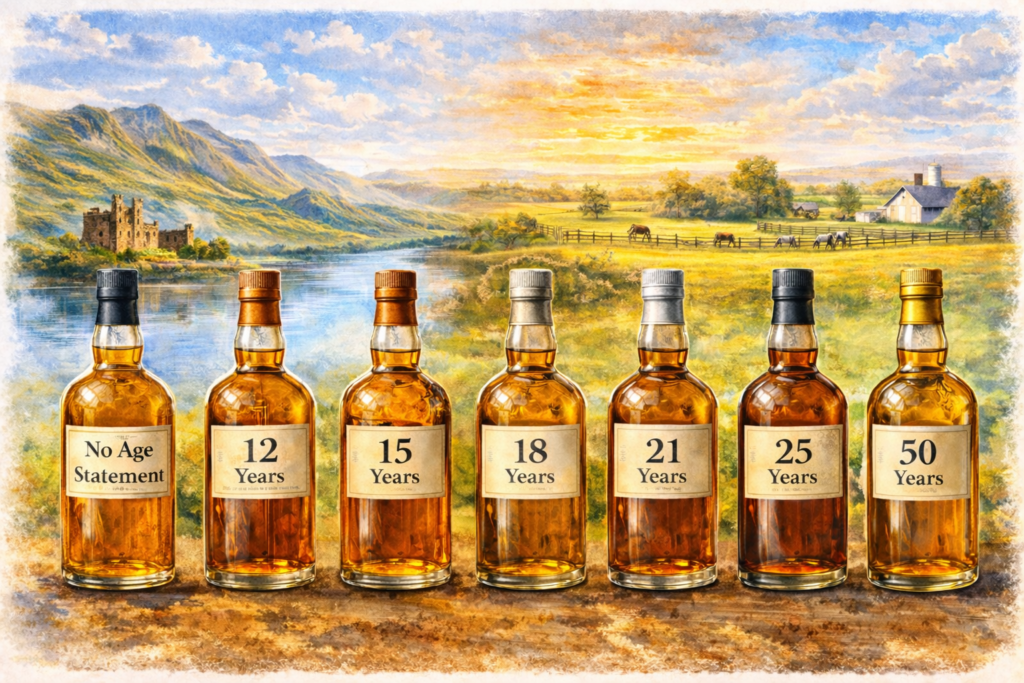
What Time in the Barrel Really Tells You
One of the things I love most about whisky is the way it forces you to slow down.
You don’t rush a good dram. You sit with it. You nose it. You take small sips and let it unfold. Whisky has a way of pulling you into the moment — not because of the alcohol, but because of the experience. The layers of aroma and flavour tell a story, and that story is shaped by time.
In this article, we’re not diving into the full history of whisky — tempting as that may be. Instead, we’re focusing on one specific part of that story: age. What it means, what it doesn’t mean, and why it’s one of the most misunderstood numbers on a whisky label.
And before we go any further, one crucial thing to clear up right away:
Whisky only ages in the barrel.
Once it’s bottled, time stands still. A 12-year-old whisky bottled in 1959 is still a 12-year-old whisky today.
What Is an Age Statement, Exactly?
Let’s start with the basics.
The age statement on a bottle refers to the youngest whisky used in that bottle.
That’s it. No averages. No rounding up. No exceptions.
Why the Youngest Whisky Matters
Most whisky is blended in some way.
- Single Malt whisky is usually a blend of multiple casks of malt whisky from the same distillery.
- Blended whisky combines whiskies from different distilleries, often including grain whisky.
- Single Cask or Single Barrel releases are the exception, coming from one individual cask.
If a whisky carries an age statement — say 18 years — every drop in that bottle must be at least 18 years old. There could be much older whisky in the blend as well. A master blender might add a 25- or 30-year-old cask to an 18-year-old whisky to shape the final profile.
You’ll almost never be told that part — and honestly, that mystery is part of the charm.
Does Age Equal Quality? (Short Answer: No)
Age statements originally emerged as a signal of quality. And while they still influence how we perceive a whisky, age is not a guarantee of quality.
What age does reliably bring is:
- More time interacting with wood
- Greater flavour extraction
- Increased complexity
- Higher cost and rarity
But complexity is not the same thing as quality.
Some whiskies are simply better when they’re younger.
How Age Shapes Flavour
Each year in the barrel changes a whisky. Oak breathes. Alcohol evaporates. Flavours concentrate, soften, or fade.
In general:
- Younger whiskies tend to be vibrant, energetic, and spirit-forward
- Older whiskies often become smoother, deeper, and more layered
But “more layered” doesn’t automatically mean “more enjoyable”.
A Peaty Example
If you’re chasing an all-out peat monster, older whisky may actually work against you.
Peat mellows with age. It integrates, softens, and slowly moves into the background. That’s why some of the most intense peated whiskies in the world carry surprisingly low age statements.
Take Octomore as a prime example. Most releases are around 5 years old — not because they’re rushed, but because that’s where the peat is at its most explosive.
Sometimes, youth is the point.
Why Older Whisky Is More Expensive
Older age statements almost always come with higher price tags, and there are solid reasons for that:
- Time costs money — decades of storage add up
- The angel’s share — whisky evaporates every year
- Scarcity increases — fewer casks survive long ageing
- Demand narrows — fewer people can afford it
That rarity drives price — but again, price does not equal quality. It reflects scarcity far more than flavour.
What Are NAS Whiskies (No Age Statement)?
NAS whiskies don’t display an age on the label — and that’s not automatically a red flag.
Age statements can be creatively limiting.
A distillery might discover that blending a tiny amount of younger whisky into much older stock creates a better result. Legally, that would force the whisky to carry the youngest age — often killing consumer interest overnight.
In other cases — especially in Japan — distilleries simply ran out of aged stock as global demand surged. Dropping age statements allowed blenders to maintain flavour consistency without misleading drinkers.
NAS removes a number, not craftsmanship.
Does Whisky Age the Same Everywhere?
Not even close.
Climate has a massive impact on maturation.
- Cool climates (Scotland): slow, gentle ageing; whiskies can mature for decades
- Hot climates (Texas, India, Australia): rapid extraction; whisky matures much faster
A young whisky from a hot climate can show wood influence comparable to a much older Scotch. That doesn’t make it better or worse — just different.
Age only makes sense in context.
FAQ: Whisky Age Explained
Does whisky keep ageing in the bottle?
No. Whisky stops ageing the moment it’s bottled. A 10-year-old whisky will always be 10 years old, no matter how long it sits on your shelf.
Is an older whisky always better?
No. Older whisky often has more complexity, but that doesn’t automatically make it more enjoyable. Some styles — especially heavily peated whiskies — can shine at a younger age.
Why doesn’t every whisky have an age statement?
Because age statements limit blending options. NAS whiskies allow blenders to focus on flavour rather than a specific number.
Can a NAS whisky be high quality?
Absolutely. Many excellent whiskies are NAS. The absence of an age statement doesn’t mean the whisky is young or inferior.
Why are age statement whiskies more expensive?
Longer ageing means higher storage costs, more evaporation, greater scarcity, and lower production volumes — all of which drive up price.
Does climate affect how whisky ages?
Yes. Whisky ages much faster in hot climates and more slowly in cooler ones. Age comparisons only make sense when climate is taken into account.
Final Takeaway: What Age Really Tells You
Here’s the DRAM1 summary:
- Age adds complexity and price — not guaranteed quality
- An age statement tells you the youngest whisky in the bottle
- NAS whiskies offer creative freedom, not shortcuts
- Climate matters as much as time
My advice?
Don’t choose a whisky by age alone. Choose it by character.
Some days call for something young, loud, and energetic. Others ask for something old, quiet, and contemplative. And some of us — myself included — simply enjoy letting the mood decide.
When it comes to whisky, what you enjoy is the only benchmark that truly matters.